Sunday, February 7, 2010

Doppler Normal Values for Prosthetic Valves

Searchable, sortable normal Doppler values for aortic and mitral valve replacements.

Around the echo lab we are politely referring to the recent JASE Guideline Recommendations for Evaluation of Prosthetic Valves as "the Beast". Both for the size of the article (40 pages!) as well as the onus of now having to perform a more exhaustive evaluation on our valve replacement patients. We were used to just imaging the valve motion, reporting peak/mean gradients, and that was that.

I have no intention here of commenting on the Guidelines per se— interested readers should familiarize themselves with the actual document. I do want to mention the appendices, however, as I saw an opportunity to contribute and improve on the published data. Well, not the data itself so much as access to the data.

The five pages of tabular data summarizing the bulk of knowledge of normal Doppler parameters for prosthetic valves should be immediately available to anyone performing/reading an echo on a patient with a prosthetic valve. This is, I am sure, the reason for publishing the data tables in the first place. An Old School approach would have us photocopy, laminate, and bind the Journal pages and then keep them in the echo lab in conspicuously useful places.

I sought to put these tables some place even more useful, and simultaneously make the information easier to sift through:

Try using the search box and sorting the data by clicking on the header columns.

NOTE: The data is straight from The Guidelines which is in turn adapted from other works. Please let me know if you find any discrepancies with the published data. If your particular valve/size is not listed, sorry.

Sunday, January 3, 2010

New Fetal Echo Z-Score References

New fetal cardiac z-score equations from William Beaumont Hospital; new online calculator at OBSONO.org

Following up on their abstract from earlier this year, the group at William Beaumont Hospital in Royal Oak, Michigan produced what turns out to be the largest cross-sectional study of normative data for fetal cardiac measurements of all time:

Fetal echocardiography: z-score reference ranges for a large patient population.
Lee W, Riggs T, Amula V, Tsimis M, Cutler N, Bronsteen R, Comstock CH.
Ultrasound Obstet Gynecol. 2010 Jan;35(1):28-34.

Data from over 2700 normal pregnancies was used to construct z-score equations for the following fetal cardiac measures:

  • LV minor
  • RV minor
  • Aortic annulus
  • Pulmonary annulus
  • Cardiac circumference

By way of comparison, the previous work from Royal Brompton used data from 130 normal pregnancies; the more recent "unpublished" equations from Boston are based on observations made on 232 normal pregnancies. This new data eclipses both of these studies by at least an order of magnitude. For the purpose of generating normative data, "n" is everything, so statistically speaking, this study is HUGE.

The William Beaumont z-score equations deal with the prediction of the standard deviation in a manner similar to that used by the Boston folks, by a separate regression, thus deliberately accounting and controlling for the natural spread of data (heteroscedasticity). And, for what has to be one of the first, if not only, time- the authors also present a beautiful frequency vs. residuals plot and convincingly demonstrate that their data conforms to a normal distribution- a predicate for all z-score comparisons.

To better examine the differences and similarities of the various z-score equations I provide these tools, allowing for side-by-side comparison of the predicted z-scores, mean values, and normal ranges:

Fetal Aortic Valve Z-Score Comparison

smackdown-aov

Fetal LV Minor Z-Score Comparison

smackdown-lv

The authors also provide their own online fetal cardiac z-score calculator ( one-upping ParameterZ.com by generating pretty z-score plots ! ) at  www.obsono.org.


Speaking from the perspective of a pediatric cardiac sonographer, I have to recognize and thank the authors of this study for doing the work that we cannot do. Those of us in pediatric cardiology do not see a high volume of unselected, normal pregnancies and thus could never generate this kind of normative data.

Sunday, November 29, 2009

Pediatric RV Function (TAPSE) Z-Score Calculator

Z-Scores for RV systolic function.

Using data published in the June 2009 JASE, this calculator determines the age-adjusted Tricuspid Annular Plane Systolic Excursion (TAPSE) z-scores:

TAPSE

Notes:

For the purpose of calculating the z-score, I used the published mean and "-3SD" lower limit to calculate each SD ([mean – lower limit] / 3)- which is a little bit off-label. That is, the standard deviation by itself is not published— only the ±2 and ±3 ranges are published— and there is some variation in how those back-calculate to "1 SD". Even though the title of the article suggest using the data for calculating z-scores, it is not perfectly clear how we are supposed to do this.

For the purpose of drawing the plot, I used the published ±2 SD values (the 2.5 – 97.5 percentiles).

While the authors note the independent influence of BSA on TAPSE (they also provide a separate graph for BSA vs. TAPSE), it is not clear to me how we are supposed to apply this information. For each age group, a TAPSE/BSA index value is determined by dividing the mean TAPSE by the mean BSA for each age group. The indexed values are noted to decrease with increasing age/BSA. However, no range of normal indexed values is given. The manner in which BSA was estimated for the study is not presented. The BSA vs. TAPSE data used to construct their graph are not published.


References:

Right ventricular function in infants, children and adolescents: reference values of the tricuspid annular plane systolic excursion (TAPSE) in 640 healthy patients and calculation of z score values.
Koestenberger M, Ravekes W, Everett AD, Stueger HP, Heinzl B, Gamillscheg A, Cvirn G, Boysen A, Fandl A, Nagel B.
J Am Soc Echocardiogr. 2009 Jun;22(6):715-9. Epub 2009 May 7.

Wednesday, November 11, 2009

Skew in Echocardiographic Reference Data

some offhand observations about the treatment of skewness in pediatric echo reference data.

Skewness:
1. asymmetry in a frequency distribution.
2. a measure of such asymmetry.

SkewedDistribution

Underlying the use of z-scores is an assumption about the symmetric nature of the distribution: the use of "Z" is because the normal distribution is also known as the "Z distribution". However, as noted elsewhere[1, 2], cardiac growth data are skewed to the right. Here are a few examples that I find remarkable.

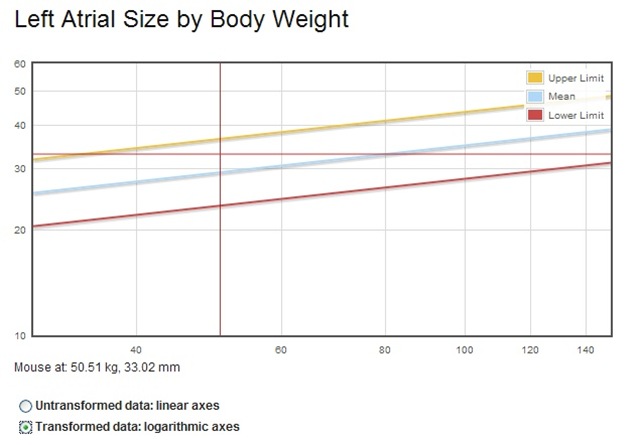
Left Atrial Diameter

Neilan et al.[3] examined the nature of the relationship of body size to cardiac structures using the left atrial diameter as measured in over 15,000 normal patients. Their plot of LA diameter against body weight—and the underlying rightward skew—can be examined here: left atrial diameter vs. body weight. Although the chart is presented in the source article with logarithmic axes, "back transforming" the axes into natural units reveals the magnitude and direction of the skew.

left_atrial_diameter_vs_body_weight

Left Ventricular Mass

Using the LMS technique to deliberately account for skew (and non-constant variance), Foster et al.[4] provide the data used to construct the following curves: left ventricular mass vs. height (I used ±1.65 for the upper and lower bounds). Interestingly, while the LMS method handles the skew and variance in a discrete (although smoothed) fashion, applying a log transformation appears to control both phenomenon as well.

lv_mass_vs_height_plot

Fetal Data

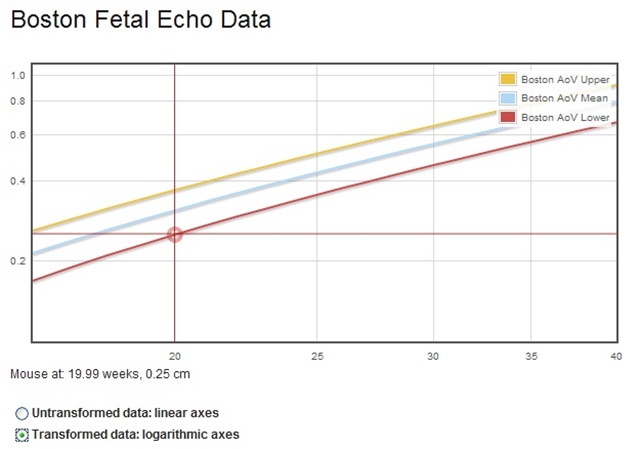
Comparing the recently published[5] fetal echo z-score data with the earlier reference[6] reveals one obvious difference: the Boston data is modeled as having a normal distribution, with no obvious skew. What, I wonder, happens if the underlying data really does have rightward skew, but is modeled as a normal distribution? Hmm...

fetal_skew


References

  1. Sluysmans T and Colan SD (2009). Structural Measurements and Adjustment for Growth. In Wyman Lai [et al.] (Eds.), Echocardiography in Pediatric and Congenital Heart Disease: From Fetus to Adult . Oxford: Wiley-Blackwell
  2. Abbott RD, Gutgesell HP. Effects of heteroscedasticity and skewness on prediction in regression: modeling growth of the human heart.
  3. Neilan TG, Pradhan AD, Weyman AE. Derivation of a size-independent variable for scaling of cardiac dimensions in a normal adult population.
  4. Foster BJ, Mackie AS, Mitsnefes M, Ali H, Mamber S, Colan SD. A novel method of expressing left ventricular mass relative to body size in children.
  5. McElhinney DB, Marshall AC, Wilkins-Haug LE, Brown DW, Benson CB, Silva V, Marx GR, Mizrahi-Arnaud A, Lock JE, Tworetzky W. Predictors of technical success and postnatal biventricular outcome after in utero aortic valvuloplasty for aortic stenosis with evolving hypoplastic left heart syndrome.
  6. Schneider C, McCrindle BW, Carvalho JS, Hornberger LK, McCarthy KP, Daubeney PE. Development of Z-scores for fetal cardiac dimensions from echocardiography.

Monday, November 2, 2009

More Fetal Echo Reference Values

Seems like I spent most of the month of October thinking about fetal echos in one form or another. Apart from the earlier release of the Fetal Echo Z-Scores: Femur Length calculator, I also developed a couple of "helper" routines:

  • A calculator to cross-check the femur length against the EGA derived from dates. Also Gives reference values for fetal thoracic circumference:

    Fetal Biometry

  • A remake of the CHOP calculator- useful for describing the hemodynamic status of the recipient twin in twin-twin transfusion syndrome (TTTS). Good stuff for reminding me about the various manners in which heart failure can be categorized by fetal echo:

    CHOP Fetal CV Profile Score

  • A calculator for fetal LV/RV/IVS wall thicknesses. In the absence of any published z-score equations, these two sources (one uses autopsy data) seem to be our only recourse:

    Fetal Ventricular Wall Thickness Reference Values


Additionally, the October 13 issue of Circulation brought a new fetal echo z-score reference:

Predictors of technical success and postnatal biventricular outcome after in utero aortic valvuloplasty for aortic stenosis with evolving hypoplastic left heart syndrome.
McElhinney DB, Marshall AC, Wilkins-Haug LE, Brown DW, Benson CB, Silva V, Marx GR, Mizrahi-Arnaud A, Lock JE, Tworetzky W.
Circulation. 2009
Oct 13;120(15):1482-90. Epub 2009 Sep 28.

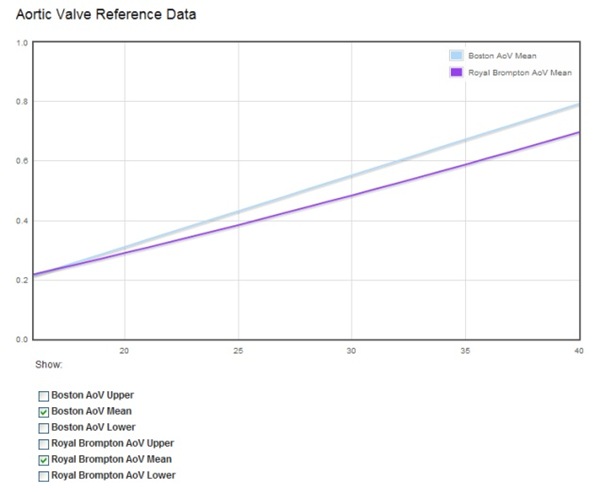
I won't attempt an analysis beyond the smackdown itself because, as the authors reveal, these new z-score equations are based on

unpublished fetal norms…

Still, it is interesting (to me) to see the data published at all, and I think the smackdown sheds some interesting light on the two groups of equations.

fetal_aov_plot