Tuesday, February 5, 2013

On the Cusp?

upcoming studies addressing the inadequacies of existing reference values for (adult) echocardiography

NORRE Study

...due to the lack of consistency in current echocardiographic ‘reference values’, their use for clinical decision-making remains questionable.

So reads the ‘background’ section of the upcoming NORRE study (NOrmal Reference Ranges for Echocardiography), enrolling subjects aged 25 – 75yrs in 22 labs (mostly in Europe).

EchoNoRMAL Study

The effectiveness of any diagnostic test is dependent upon the test’s ability to accurately detect abnormalities. An assumption of reliability and validity underlies all medical tests and echocardiography is no exception. The definition of ‘abnormal’ relies on the definition of ‘normal’ and needs to acknowledge normal physiological variation that may arise from factors such as body size, gender, and ethnicity.

So reads the introduction of the EchoNoRMAL study, an effort by ambitious scientists in New Zealand. Also concerning adults, aged 18 and up.


Looks like the adult echo community is winning.

Friday, January 18, 2013

The Why and How of... What the?

Print is dead.

When the editorial process of a peer-reviewed journal deteriorates as it does in the January JASE issue, then I think it is safe to say print is dead.

What was destined to be The editorial concerning z-scores for echocardiography will now only make sense if we read the coming errata, which diffuses the point entirely. I considered writing a letter to the editor, but it is not obvious to me that they would bother to read the submitted material or, are at all familiar with the subject.

Not sure what I am driving at? Read the editorial yourself and see if you can make sense of how-- all of a sudden-- we are now supposed to be adjusting cardiac size for body mass index 
(Hint: we’re not. It’s a colossal misprint).

Thursday, December 13, 2012

Scaling in Echocardiography: Psychosis

A recent editorial states “In terms of practicality, developing normative values of right-heart dimensions by indexing to BSA is an important first step and should be encouraged.” If by “encouraged” they mean “discouraged and abandoned” then I totally agree.

An editorial in the December JASE discusses recent additions to the body of knowledge concerning reference values for the right ventricle:

Editorial:

Recent articles:

That reference values for the right ventricle need to be improved is undisputed. However, I think the editorial went awry and gave some of the authors an undeserved pass.

Firstly, as a matter of clarification, I believe the current guidelines for the right ventricle are unsuitable. Here’s why: they provide unscaled values:
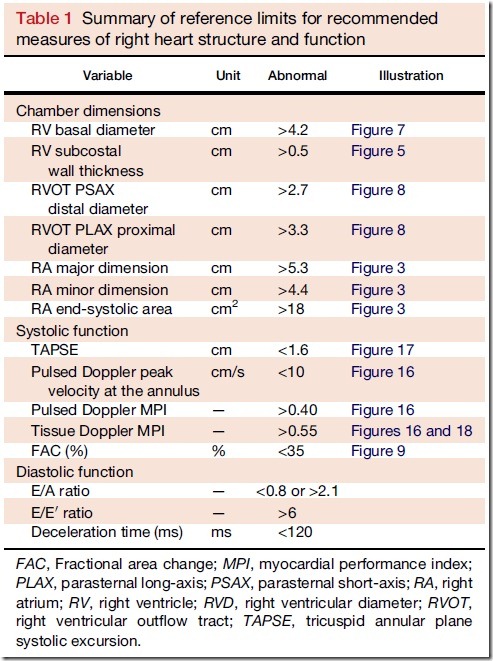
ASE_right_heart_ref_vals

In fact, the terms “scaled” and “body size” do not appear in the guideline document.
Anywhere.

Secondly, the editorial nicely details many of the shortcomings of indexing (i.e., heart size ÷ body size):

This approach is problematic for three reasons. First, the correlation between the cardiovascular parameter and body size may not be linear and may have unanticipated variation; second, difficulties may result when scaling a cardiovascular parameter to a body size parameter that has different dimensions (e.g., volume vs. area); and finally, it has been shown that ratiometric scaling does not produce size-independent scaled cardiovascular variables (i.e., the ratiometrically scaled variable (still) correlates with body size).

Yet the final assessment of the editorial is that indexed values are a “practical compromise”:

Indexing to BSA is a practical compromise but is inaccurate insofar as body composition affects the relation between body mass or surface area and cardiovascular variables; this problem may be particularly troublesome when normalizing dimensions in obese populations... In terms of practicality, developing normative values of right-heart dimensions by indexing to BSA is an important first step and should be encouraged.

There is some real truth in the problematic matter of using BSA as the size-adjusting parameter. The cardiovascular system has been optimized to deliver oxygen to tissues with a high metabolic need for it, i.e., lean body mass. Body surface area is a poor surrogate for LBM and, therefore, poorly represents the true relationship between body size, cardiac output, and organ size. But that is a problem for every attempt to scale heart size to body size, and not a unique problem for indexing. Indexing has it’s own flaws—fatal flaws—and couching those flaws in the terms of “BSA may be inadequate for obese populations” is misleading.

To be fair, the article by D’Andrea et al. understands the perils of indexing, and they should be recognized for their approach:

On the basis of the theoretical and empirical limitations of ratio scaling, we checked whether this scaling approach removed the influence of body size using a simple bivariate correlation approach. Where ratio scaling failed to remove the influence of body size, we subsequently investigated the nature of the allometric relationships between the BSA and 3D RV volumes and determined whether allometric scaling for the BSA provided size-independent RV dimensional indexes. Allometric scaling of the general form y = a * xb was used.


In my opinion, the most rational piece of work covering the matter is the fantastic editorial, Does size matter? Clinical applications of scaling cardiac size and function for body size. It is so relevant to the topic, it was cited in the current editorial 4 times. However, those authors arrived at the entire opposite conclusion:

indiscriminate use of ratiometric scaling approaches is at best problematic and at worst dangerous...

Reliance on parameters ratiometrically scaled to BSA for clinical decision making should be discouraged.

What we need in echocardiography is something of a reality check...

Stay tuned for that:
A Review and Critique of the Statistical Methods Used to Generate Reference Values in Pediatric Echocardiography.

Saturday, November 24, 2012

LVEDV Z-Scores

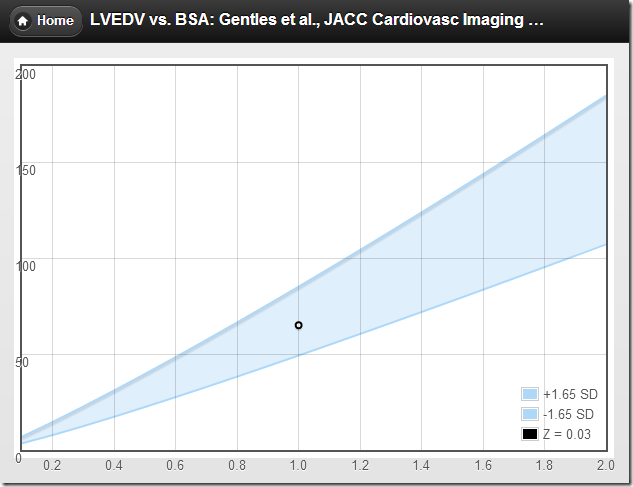
The second of two recent updates to app.parameterz.com is the addition of the left ventricular volume and dimension data supplied by this recent article:

Normalized end-systolic volume and pre-load reserve predict ventricular dysfunction following surgery for aortic regurgitation independent of body size.
Gentles TL, French JK, Zeng I, Milsom PF, Finucane AK, Wilson NJ.
JACC Cardiovasc Imaging. 2012 Jun;5(6):626-33.
(The equations are provided via an online supplement, supplied to me by the authors.)
Although the article describes equations for LV function and dimensions, I use only the dimensional z-scores. The form of these equations is that of an allometric relationship with BSA, with log-log transformation of both the measured value and the BSA.
The formula used for estimating BSA is not described within the article/supplement; I am awaiting a response from the authors on this. In the meantime, calculations are made using the Haycock formula.

LVEDD and LVESD

The allometric equations for the LVEDD and LVESD use exponents of around 0.4, which is slightly less than what would be expected by the theory of geometric similarity: 0.5. Numerous other authors have discovered linear relationships when correcting/adjusting linear dimensions (cm) to body surface area (m2). Additionally, the LVESD values seem a bit off when compared to other available sources:
image
(I have contacted the authors; awaiting their response)

LVEDV and LVESV

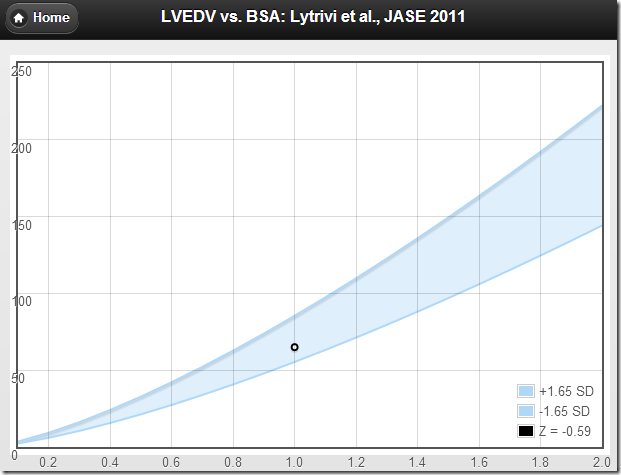
Data for the left ventricular volumes is also in the form of an allometric relationship with BSA, with an exponent of around 1.1. Again, this differs somewhat from what would be predicted by geometric similarity, and by other empirical evidence. The closer the exponent is to 1.0, the more the relationship is strictly linear with BSA, which is unexpected, particularly since the authors recognize this peril:
However, the relationship between body size and LV size is nonlinear
Yet, when you plot out the predicted values, it looks quite linear:
image
versus an allometric equation with an exponent of 1.38 (Lytrivi et al.):
image
Anyhow, given the paucity of ventricular volume z-score equations, these are now included among other pediatric echo z-score calculations at

app.parameterz.com


***update Dec 2012***
The author has advised me that there was an error with the online supplement.
"The intercept for ESD should be 2.56 NOT 3.56 as is on the web"
The app now uses the updated value.

Friday, November 23, 2012

Left Atrial Volume Z-Scores

Calculating BSA-adjusted z-scores of LA volume using an allometric equation
The first of two new calculations added to app.parameterz.com is based this recent article:

Normal values of left atrial volume in pediatric age group using a validated allometric model.
Bhatla P, Nielsen JC, Ko HH, Doucette J, Lytrivi ID, Srivastava S.
Circ Cardiovasc Imaging. 2012 Nov 1;5(6):791-6.

Similar to how this same group calculates z-scores for LV end-diastolic volume, they found an allometric equation that scales well with body size (in this case, two equations) and they index to that. For left atrial volume, there is one equation for BSA ≤ 1.0 and another equation for BSA > 1.0. The allometric exponent for the bigger kids, i.e., BSA1.08, is not much different than just indexing to BSA, which strikes me as interesting.
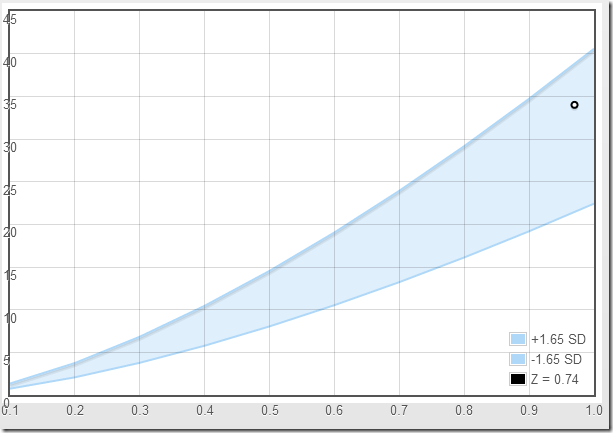
I think the stratification into two groups would be more palatable if the interface was seamless, but in this case it is not. Let’s have a look at two patients with an LA volume of 34ml, one just under 1.0 meters squared and the other, just above.
  1. BSA = 0.97; z = 0.74
  2. BSA = 1.03; z = 1.65
And their accompanying plots:

BSA = 0.96

image

BSA = 1.03

image
For the smaller patient, the LA volume of 34 ml is well within the normal range, but for the slightly larger patient, the same LA volume is now at the upper limit of normal. Weird, huh?
Plus, it gets a little more interesting. If we assume that 125-131 cm is about the appropriate height for a 7 year old, and we plug the same data into another calculation, the indexed left atrial volume is definitely large, with a z-score of 3.5:
image
Anyhow (as always) I don’t pretend to have the answers— I just pose questions. Feel free to play around with this and other z-score calculations at:

app.parameterz.com